

"LOOK WHAT THEY'VE DONE TO MY SONG, MA" BY MELANIE (1970)
or, "why season 4 of 'Hannah Montana' is a post-modern masterpiece"

This week, Miley Cyrus released her new single, “Flowers”. So I thought this would be the perfect opportunity to talk about my favorite Miley performance of all time.
The Hannah Montana mirror
When Hannah Montana ended in 2010, all eyes were on Miley. She was arguably Disney’s biggest star ever, and if she played her cards right, she’d be the channel’s biggest success story. While predecessors of Hilary Duff and Raven-Symoné struggled to find success in their post-Disney careers, Miley already had hits on the Billboard Hot 100. And though many scholars — including myself — have often grouped Miley in with all the other teen stars of her time, she’s actually a force all her own, and perhaps one of the most fascinating cases of teen stardom in all of Hollywood.
The biggest reason for her unique trajectory is the very show that made her a star: Hannah Montana.
The show grew from a simple idea: what if you were both a popstar and a regular teenage girl? Ironically enough, the show’s rise made Miley Cyrus anything but a regular teenage girl, and the struggles that Miley Stewart (the character) would face quickly began to mirror Miley Cyrus’ life. Or was it the other way around?
(Also, let’s not include Miley Cyrus in the nepo baby discourse, okay? If anything, Billy Ray is Miley’s nepo baby, full stop.)
I spend a lot of time thinking about the fourth and final season of Hannah Montana, which is one of the most provocative, post-modern seasons of television of the last 20 years. Following the events of Hannah Montana: The Movie, Miley Stewart finds herself missing Tennessee and the simple life she had there. She also feels conflicted about keeping her identity a secret as she navigates relationships and life-changing career opportunities.
The season, promoted as Hannah Montana Forever, opens with the Stewarts moving into a new home on a private, secluded ranch as Miley struggles to reclaim her down-home roots. In episode 9, titled “I’ll Always Remember You,” Miley Stewart decides to reveal her true identity to the world. There’s a scene just before the reveal where she’s cycling through her Hannah closet, reminiscing on all the iconic outfits and performances she’s given as the pop star. This is moment is striking and complex, because as Miley Stewart says goodbye to Hannah Montana, Miley Cyrus is also saying goodbye to the two characters who built her legacy. And while the personality of Miley Stewart was semi-autobiographical, Miley Cyrus would never take up the mantle of Hannah Montana again. This was not just the end of the show, but the end of an unusual chapter of a unique career.
And now, Miley Cyrus had a challenge to face: how do you become your own person when you’ve been playing three different roles your entire life?
While lesser sitcoms would end the show after the de-wigification, Hannah Montana Forever boldly explores the aftermath of Miley Stewart’s decision. The media is in an uproar, some calling her a liar, some sympathizing with her desire for privacy. Many questioned “Why now?” and Miley Stewart struggles to deal with the loss of both sides of her identity by giving her whole self to the world.
For the first and maybe only time in its legacy, Disney Channel addresses the cycle of stardom it has created. As Miley Stewart is under fictional fire, Miley Cyrus is facing her own set of frenzied media controversy: the controversial Vanity Fair photoshoot, the leaked photos of her smoking a bong, and her online vlog feud with Demi Lovato and Selena Gomez all happened while Hannah Montana was still on air. And because people never saw her as Miley Cyrus — only as Hannah Montana or Miley Stewart — her actual identity was trapped in a vortex of the show’s success. Her personal “failures” were always held to the standard of two girls she never was. Yeah, Selena Gomez played a wizard, but no one ever actually thought she was a wizard. But Miley was always being Miley.
So, how do you rebrand being yourself with… being yourself?
“Well, if the people are buying tears, I'll be rich someday.”
—”Look What They’ve Done to My Song” by Melanie
[Interlude]: Leaving the land of fame and excess
In the midst of Hannah Montana Forever, Miley Cyrus released Can’t Be Tamed, an album best known as Miley’s “departure” from “kid-friendly” pop. The issue, though, is that Miley tried to revamp her image while still releasing music with Hollywood Records, the label that produced and distributed music for the Disney Channel. This made it even more difficult than usual for Miley to shed her Disney persona, as the people with power over her music were essentially the same.
Three years later, Miley Cyrus would release Bangerz, her controversial “hip-hop” (and I use that phrase quite liberally…) album under RCA Records. It produced a #1 hit (“Wrecking Ball”), Miley’s first Grammy nomination for Best Pop Vocal Album, has been certified triple-platinum, and has been named by multiple publications one of the best albums of the 2010s. Through Bangerz, Miley reinvented her image with a hard left-turn, and whether you liked it or not, it worked.
But in the brief time between departing Hollywood Records and signing to RCA, Miley sat in her backyard and played a couple songs.
The Backyard Sessions
2012 was the peak for “Miley Cyrus aesthetic”: the long brown extensions, the short denim shorts, always the coffee in hand, always a Hemsworth on her arm. I swear, every year (look at the timestamps), some post goes viral along the lines of, “she was a vibe freal !!!” with four paparazzi photos of Miley wearing a flannel and beanie on the streets of Hollywood. And I will retweet it every time.


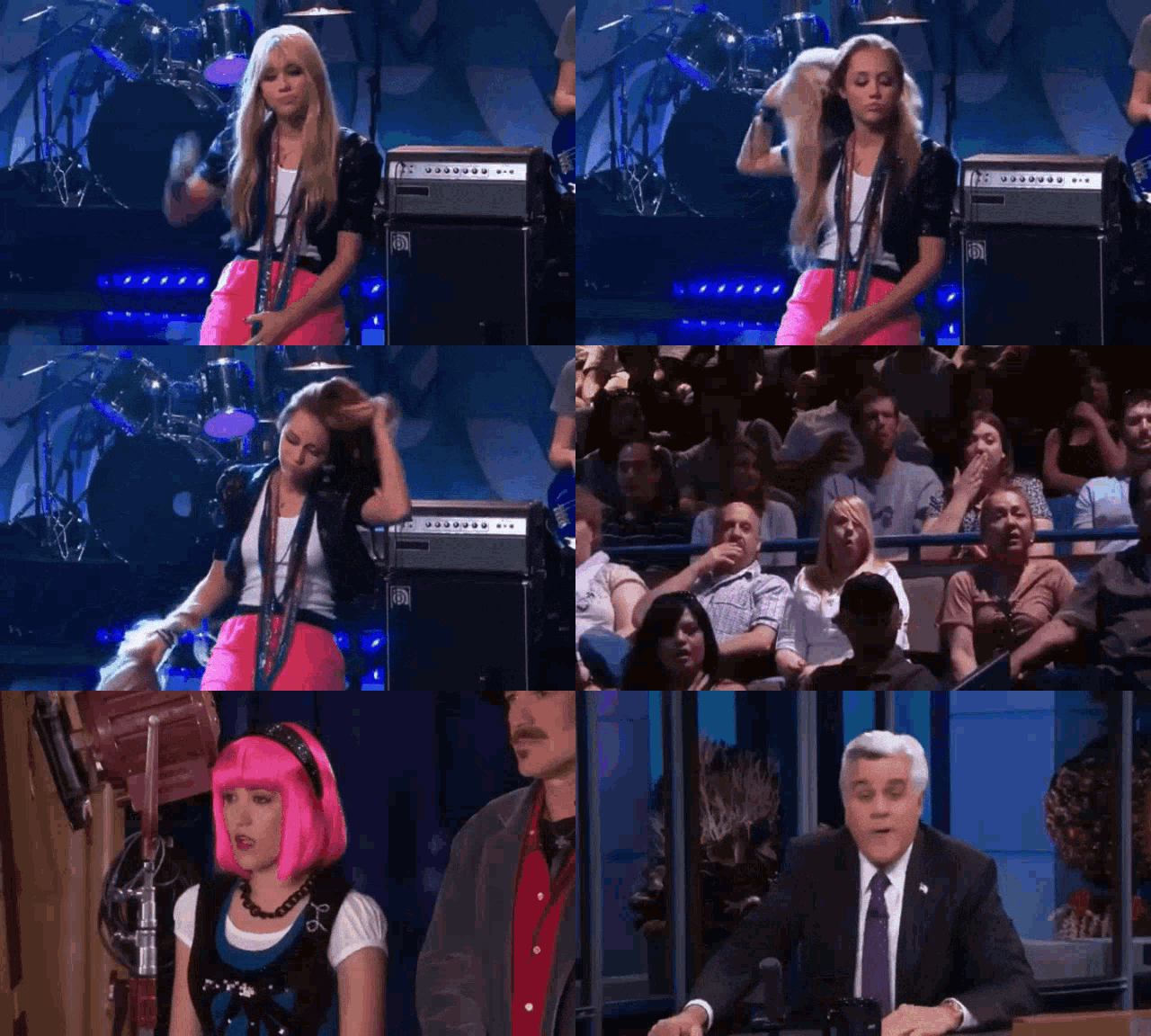
Following the release of Can’t Be Tamed, Miley toured Latin America, Australia, and literally just the Philippines (like, no other countries in Asia), before taking a break from music and pivot to smaller acting roles. But as social media evolved into the monster we know it as today, Miley quietly released three videos that changed the trajectory of her career forever.
The Backyard Sessions started as a short series of videos recorded by Miley in her backyard featuring stripped-down, acoustic covers of her personal favorite songs. In later years, The Backyard Sessions would become a staple of Miley’s oeuvre — for many, this was the first time you could really hear Miley’s voice, sans autotune, and sans wig (but plus extensions, of course). She covered “older” songs that made adults pay attention and give backhanded compliments like, “Oh, she’s actually really talented!” Hearing her raw voice and passion while singing songs she truly loved was her A Star is Born parking lot moment, and the world was drunk Bradley Cooper vowing to make her a star.
The most popular of these videos is “Jolene,” a Dolly Parton cover that’s now part of Miley’s onstage repertoire. But my favorite of the original covers is of a song I hadn’t heard until Miley sang it, and the subject of this very essay.
“Look What They’ve Done to My Song” was released in 1970 by American folk singer Melanie. Originally titled, “What Have They Done to My Song?” the song explores themes of exploitation and losing control over one’s life. The lyrics are repetitive, but with a purpose: cries for help become chants become mantras become reasons to survive. It’s meditative, almost like a solemn hymn: parsing out equal parts grief and liberation at the idea of losing one’s agency to the opinion of others.
“Look what they've done to my song, ma
Look what they've done to my song
Well, it's the only thing that I could do half right
And it's turning out all wrong, ma
Look what they've done to my songLook what they've done to my brain, ma
Look what they've done to my brain
Well, they picked it like a chicken bone
And I think I'm half insane, ma
Look what they've done to my song.”
I didn’t know anything about Melanie before this, but I sure know a lot about Miley Cyrus. And upon hearing this for the first time back in 2012, I was stunned to learn the song was a cover. The lyrics were too apt, too fitting; her voice too emboldened, as if her vocal cords were molded just to sing these lyrics. It’s like listening to “Lucky” by Britney Spears in the wake of her conservatorship; how could they sell her with the very chains they promised to free her from?
From “Lucky” by Britney Spears:
“Lost in an image, in a dream
But there's no one there to wake her up
And the world is spinning, and she keeps on winning
But tell me: what happens when it stops?”
The most heartbreaking moment of the cover is towards the end, when Miley stretches her voice thin over the phrase, “And maybe I’ll be okay.” It’s a rare moment where Miley’s impeccable vocal control is challenged by her own emotions, her heart overtaking her skill. This cover felt like Miley’s way of reaching out before she had the liberty to speak for herself. She used someone else’s words — much like she used someone else’s persona — to vocalize her own frustrations and fears.
The Backyard Sessions Forever
In the years following the release of Bangerz, Miley reinvented herself so many times that what the media dubbed as “crazy” became normal. She did whatever she wanted to do until people became bored with her antics, and now she’s a loved and respected artist. Funny how that works.
A lot has been written about Miley, Bangerz, and the way white artists co-opt Black art for their “rebellious” phase, profiting off of Black culture with little to no credit given to Black people.
Writer Michael Arceneaux said for Teen Vogue in 2017:
Much has been written about America’s obsession with what is often referred to as “black cool.” In 2015, Ebony magazine's then editor in chief, Kierna Mayo, ran a simple yet audacious statement on its cover: “America Loves Black
PeopleCulture.” It’s an exhausting dichotomy, but while the public at large loves facets of black culture, black people remain beset with lingering prejudices about who we are. As a black man, I am cool but also dangerous. Black women, meanwhile, are also perceived as cool and are subjected to gross stereotypes purporting hypersexuality.Yet, when white people engage in traditional black art forms, they reap the benefits without any of the difficulties attached. So Miley and many of her contemporaries are just like Christina Aguilera in cornrows when she needed to venture away from bubblegum pop to remain a pop culture force. The same can be said of Justin Timberlake when he needed to escape the boy-band tag and stand as his own solo adult male star. Miley is merely the latest incarnation of an ongoing American cultural pastime.
She’s since apologized and misspoke dozens of times, pivoted to folk, pivoted to rock, reclaimed her Disney-era hits with an experimental flare, and faded into being a “regular celebrity” vs. someone who is constantly on the brink of scandal.
In 2015, she revived the Backyard Sessions to promote her the Happy Hippie Foundation, a nonprofit focused on combating homelessness among LGBTQ+ youth. Miley invited Melanie to perform a new cover of “Look What They’ve Done to My Song,” the song taking on a happier tone, Miley’s voice more playful, more free.
In the videos, Miley sported a new blonde pixie cut, reclaiming Hannah’s signature hair color for her own.
[Epilogue]: Meet Miley Cyrus
The series finale of Hannah Montana ends with Miley Stewart choosing to go to college as Miley, joining her best friend, Lilly, at Stanford University (#gobears). It’s sweet and probably a good message to spread to kids: Be practical! Go to college! Love your friends!
But an alternate ending was added to the season’s DVD release. In it, Miley Stewart takes the other path: she flies to Paris to shoot a film with Steven Spielberg (??? like, you picked college over that???) and says a tearful goodbye to Lilly at the airport. The shot pans to a little girl at the airport with her mother, combing the hair on a Hannah Montana doll. The doll then fades into a generic blonde Barbie doll, and we hear a young girl singing offscreen. The following title appears:
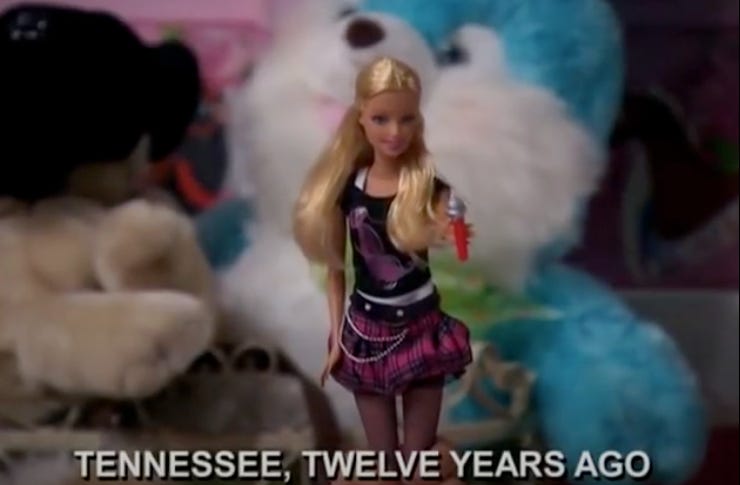
The camera pans out to reveal a little girl with short brown hair and piercing blue eyes, singing about wanting to become a rock star. Billy Ray Cyrus peeks into the room, smiling at who is, presumably, young Miley. But alongside him not Brooke Shields, who portrayed the role of Miley Stewart’s mother for the whole of the series. Instead, Billy Ray is standing next to Tish Cyrus, Miley Cyrus’ biological mother.
The first time I saw this, I thought I was losing my goddamn mind. Had they made a mistake in the production? Were they retconning Tish as Miley Stewart’s mother?
But with one single line, Billy Ray Cyrus broke the space-time continuum of the Miley-Miley-Hannah extended universe: “Miley Cyrus, why are you still up? You know it’s past your bedtime!”
Here, at the end of a uniquely meta-textual children’s series, we get a glimpse into young Miley Cyrus’ bedroom as she day dreams about someday growing up to be… a blonde rock star.
As the Cyrus’ tuck fake Miley into bed, she looks up at them and says: “I really am gonna be a rockstar someday. Just like daddy.”
This absolutely broke my brain. This alternate ending is insinuating that by playing role of Miley Stewart, a girl who wanted to be a rockstar so badly that she created a new identity for herself, Miley Cyrus was fulfilling her own lifelong dream. The show itself is proposing that Miley’s own hopes and dreams were inextricably tied to the show’s success. But the show didn’t just make Miley Cyrus famous; it made Hannah Montana famous first, making Miley’s actual life into the plot of the show.
And now they’re rewriting her childhood, too.
“Because if people are buying tears, we’ll be rich someday, ma.”